

How to Build a Brand from Scratch: A 7-Step Incubation Guide for Emerging Designers & Creative Entrepreneurs

The complete roadmap — from raw ideas and brand identity to product launch and market growth — with AD+L Studio as your creative partner.
You have a creative vision. A distinct aesthetic. A product concept that wakes you up at night with excitement. You can picture it clearly — the colours, the materials, the feeling it would create in someone’s home or hands. What you are less sure about is everything else: How do you turn this vision into a real brand? How do you build an identity that commands attention and trust? How do you get from a sketchbook to a shelf, a showroom, or a bestselling launch?
These are the questions that stop most talented creatives from ever taking the leap. Not lack of ability — but lack of roadmap. Building a brand from scratch is one of the most exhilarating and demanding undertakings a designer or entrepreneur can attempt. It demands equal parts of creativity and strategy, artistic vision and commercial intelligence, personal conviction, and market awareness.
This guide lays out a clear, step-by-step brand incubation process — the same framework we use at AD+L Studio when we work with emerging designers and creative entrepreneurs who are ready to build something real. Each step has a specific purpose, a clear set of actions, and a tangible outcome. Together, they form a roadmap from the first spark of an idea to a launch-ready brand with a distinctive identity, a product line, and a path to growth.
AD+L Studio’s Brand & Designer Incubation service is built for this journey. We work hands-on with emerging creatives, start-ups, and entrepreneurs — providing brand strategy, identity development, product road-mapping, mentorship, and full manufacturing support — so your brand launches with clarity, confidence, and commercial strength.
STEP 1 Clarify Your Vision, Values & Brand Purpose
Every powerful brand begins with a clear and honest answer to one fundamental question: Why does this brand exist? Not just ‘to sell products — but what deeper purpose, perspective, or point of view does it bring to the world? Brands built on a genuine answer to this question to develop loyal audiences. Brands that skip it remain forgettable.

At this stage, articulate:
- Your personal creative philosophy — what do you believe about design, craft, materials, or living?
- The problem or gap your brand addresses — what is missing in the market that your vision can fill?
- Your core values — sustainability, craftsmanship, accessibility, cultural heritage, innovation?
- Your non-negotiables — what will your brand never compromise on, regardless of commercial pressure?
- Your long-term vision — where do you see this brand in five years? Ten?
This is not a marketing exercise. It is an act of honest self-reflection that becomes the north star for every subsequent decision — from product design to pricing, partnerships to packaging. Brands that know what they stand for make better decisions faster, and attract the right customers, collaborators, and press from the start.
Many emerging designers underestimate this step, rushing past it to get to the ‘exciting’ part of sketching and designing. The result is a brand that looks interesting but feels hollow — and struggles to build lasting loyalty.
In working with Aria Desai, a Brooklyn-based furniture designer who came to AD+L Studio with a sketchbook full of beautiful ideas and a deep commitment to sustainable luxury, the first thing we did together was articulate her brand purpose: ‘Earth-made elegance.’ This two-word anchor became the filter through which every subsequent decision was evaluated — from material sourcing to pricing strategy to the events she participated in.
STEP 2 Define Your Target Audience & Market Position
Once your brand’s purpose is clear, the next question is: Who are you building this for? Great design does not speak to everyone — and brands that try to do so end up speaking to no one. Knowing your audience with precision allows you to make smarter design decisions, more targeted marketing choices, and more compelling brand communications.
Build a detailed profile of your ideal customer:
- Demographics — age, location, occupation, income bracket, lifestyle habits
- Psychographics — values, aspirations, what they read, who they follow, what they already buy
- Purchase behaviour — how do they discover new brands? What triggers a buying decision?
- Relationship with design — is design a casual interest or a core part of their identity?
- Pain points — what frustrates them about what currently exists in the market?
Alongside your audience profile, you need to map your competitive landscape. Who are the other brands operating in your space? Where do they sit on the axes of price and quality, traditional versus contemporary, mass-market versus exclusive? Understanding the competitive terrain is not about copying what works — it is about identifying the white space where your brand has a genuine right to win.
Establish your market positioning:
- What tier are you targeting — accessible, mid-market, premium, luxury, ultra-luxury?
- What is your price architecture, and does it reflect your brand values and material investments?
- What channels will carry your brand — direct-to-consumer, wholesale, retail partnerships, hospitality contracts, trade sales?
Your positioning is not just a marketing decision — it shapes every aspect of how you design, produce, price, and communicate your brand. Get it right early and every subsequent decision becomes clearer.
STEP 3 Build Your Brand Identity
Brand identity is the visible, tangible expression of your brand’s invisible values and purpose. It is the sum of every visual and verbal signal that communicates who you are before a potential customer has seen a single product — and it continues to reinforce that promise at every touchpoint, from your website and packaging to your social media and trade show presence.

A complete brand identity includes:
- Brand Name: Clear, memorable, and distinctive. It should resonate with your target audience and ideally reflect your brand’s essence without being too literal or restrictive as the brand grows.
- Logo & Visual Mark: The visual anchor of your identity — designed with versatility in mind, so it works at any scale, in any colour environment, on any surface.
- Colour Palette: A curated selection of primary and secondary colours that evoke the right emotional response for your brand. Colours carry deep psychological associations — they must be chosen deliberately.
- Typography: The fonts your brand uses communicate personality — authoritative, playful, elegant, industrial, humanist. Typography consistency builds recognition.
- Photography & Art Direction Style: The visual language of how your products are photographed, styled, and presented. This is one of the most powerful brand signals in the digital age.
- Brand Voice & Tone: How your brand communicates in writing — the words you use, the rhythm of your sentences, the personality that comes through in every caption, product description, and press release.
- Brand Guidelines Document: A living document that ensures every piece of brand communication — now and in the future — is consistent, intentional, and on-brand.
Brand identity is not decorated. It is the first impression that shapes whether a potential customer trusts your brand enough to explore it further. In a crowded market, the difference between a brand that gets noticed and one that gets scrolled past is almost always the quality and coherence of the visual identity.
AD+L Studio works with emerging designers to develop complete brand identities that are both strategically grounded and aesthetically distinctive — ensuring your brand looks and communicates in a way that matches the quality of the products you create.
STEP 4 Develop Your Product Roadmap & First Collection
A brand is ultimately defined by its products. Once your identity is established, it is time to translate your creative vision into a structured, commercially viable product line. This requires both design thinking and business planning — the two must work in concert.

Your product roadmap should define:
- Hero Products vs. Supporting Range: Identify the 1–3 signature pieces that will define the brand’s aesthetic and drive initial attention. Surround them with a supporting range that offers entry points at different price levels or scales of commitment.
- Collection Architecture: How many SKUs in your launch collection? What is the logic that holds them together as a family — shared materials, a design language, a thematic concept?
- Price Points & Margin Structure: Every product must be designed with its retail price and unit production cost in mind from the very beginning. Reverse-engineer from the price your target customer will pay to the cost you can afford to produce at.
- Production Volumes: Will you launch with limited edition runs to create scarcity and exclusivity, or with larger quantities to serve a broader market? Volume decisions affect your manufacturing approach, pricing, and brand positioning simultaneously.
- Seasonal & Growth Strategy: Is this a year-round collection or a seasonal capsule model? How do you plan to evolve the range — new colourways, new forms, new materials?
With the roadmap defined, the design process begins in earnest — mood boards and trend research feeding into sketch development, sketch development into CAD and material specification, and material specification into prototyping. At every stage, the product must be evaluated against the brief: Does it look like our brand? Does it perform as required? Can it be produced at the right cost and quality?
“For the first time, I felt like I had a team and resources that truly respected both my vision and my values.” — Aria Desai, Brooklyn-based Designer & AD+L Studio client
STEP 5 Build Your Supply Chain & Manufacturing Foundation
One of the most consequential and under-appreciated challenges of launching a brand is building the supply chain that will actually produce your products — consistently, at the right quality, at the right cost, and with the right ethical and environmental standards. This is where many emerging brands stumble badly, often expensively.

Key supply chain decisions:
- Material Sourcing: Where do your materials come from, and can you verify their origin, quality, and ethical provenance? For brands with sustainability credentials, material traceability is non-negotiable — and increasingly, it is what discerning consumers demand.
- Manufacturing Partner Selection: Finding the right factory or workshop is one of the most important decisions a young brand makes. The right partner understands your quality standards, shares your values, communicates proactively, and can grow with you. The wrong partner undermines everything else.
- Minimum Order Quantities (MOQs): Most manufacturers have MOQs — minimum quantities per production run. Understanding these early is critical: they determine how much capital you need to tie up in inventory, and they affect your pricing and cash flow from day one.
- Lead Times: From confirmed order to delivered goods, how long does production take? Lead times vary dramatically by product type, material, and manufacturing location. Plan your launch timeline around real lead times, not optimistic ones.
- Quality Control: Establish clear quality standards before production begins and have a process for inspecting goods before they ship — whether through in-house QC, a trusted agent on the ground, or a third-party inspection service.
For emerging brands, gaining access to quality manufacturing partners can be one of the most significant barriers to entry. Factory relationships are often built on trust accumulated over years and volume commitments that new brands cannot offer. This is where having an experienced partner with an established network becomes genuinely transformative.
When Aria Desai needed access to FSC-certified timber suppliers in Indonesia, artisan co-ops in India using traditional pit-loom techniques, and a zero-waste brass foundry — AD+L Studio’s established global network opened doors that would have taken years to access independently. Our relationships are your relationships.
STEP 6 Plan & Execute Your Market Entry
Building the brand and the product is only half a challenge. The other half is getting it in front of the right people, at the right moment, through the right channels. A beautiful brand with a great product and a weak market entry strategy will underperform. A well-planned launch creates momentum that compounds — press coverage leads to retailer interest; retailer interest leads to more press coverage, and so on.

A strong market entry plan covers:
- Launch Channel Strategy: Where will you sell first? Direct-to-consumer via your own website? Through a curated retail partner? Via trade sales to interior designers and architects? Each channel has different margin structures, audience reach, and brand implications.
- PR & Press Strategy: Identify the publications, platforms, and journalists whose audiences match your target customer. Prepare a compelling press kit — brand story, high-quality product photography, founder narrative — and build relationships with relevant editors and writers before your launch.
- Trade Shows & Design Events: For design and lifestyle brands, trade events like Milan Design Week, ICFF New York, Maison & Objet Paris, and regional design fairs provide unmatched access to buyers, press, and peers. Participating strategically — even on a modest budget — can be transformative for brand visibility.
- Digital & Social Strategy: Define your content approach: What platforms will you prioritise? What story will you tell, and in what format? For design brands, Instagram and Pinterest remain primary visual platforms, but long-form content, editorial storytelling, and video are increasingly powerful.
- Community & Collaborations: The most effective early brand growth often comes from genuine collaboration — with complementary brands, with interior designers who become advocates, with architects who specify your products, and with a community of like-minded customers who share your values.
Timing matters enormously. Launching too early — before the supply chain is solid, the identity is complete, or the product is ready — can damage a brand’s reputation in ways that are difficult to recover from. Launching with everything in place, on the other hand, creates a moment of genuine impact.
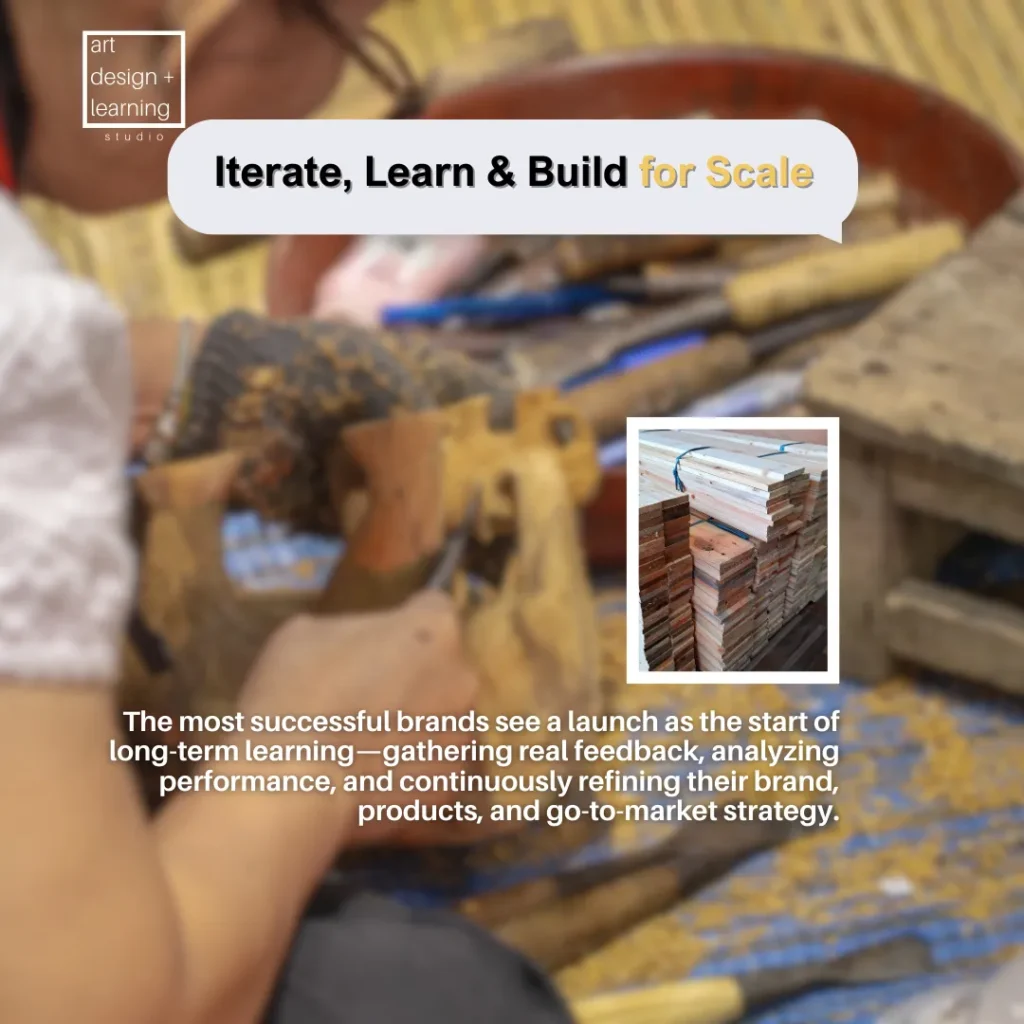
STEP 7 Iterate, Learn & Build for Scale
Launch is not the destination — it is the beginning. The most successful brands treat their launch as the opening of a long-term learning process: gathering real-world feedback from customers, retailers, and the press; analysing what performs and what does not; and using those insights to refine the brand, the product line, and the go-to-market strategy continuously.
Post-launch priorities:
- Customer Feedback Loops: Talk to your customers — genuinely and regularly. What do they love? What would they change? What prompted their purchase decision? This intelligence is invaluable and cannot be replicated by any market research exercise.
- Sales Data Analysis: Which products are selling fastest, and at what margin? Which channels are performing, and at what acquisition cost? Data-driven decisions compound over time into significant competitive advantages.
- Product Line Evolution: Use the first collection as both a commercial vehicle and a learning exercise. What does it tell you about the next collection? What should you add, what should you refine, and what should you retire?
- Brand Building vs. Revenue: Early-stage brands must balance investing in brand awareness and prestige (which pays off over time) by generating the revenue needed to sustain operations. This tension is real and navigating it well requires clear thinking about priorities.
- Scaling Production: As demand grows, your supply chain must grow with it — without sacrificing quality or the brand values that drove your initial success. This requires proactive conversations with manufacturing partners, potentially new supplier relationships, and careful inventory management.
The brands that endure — that become genuine cultural and commercial presences — are not those that got lucky with a great launch. They are the ones that built rigorous processes for learning and iteration, stayed true to their founding values as they grew, and surrounded themselves with partners and advisors who helped them navigate each new stage of growth with intelligence and creativity.
Real Story: How AD+L Studio Helped Aria Desai Go from Sketchbook to Sold-Out Collection
When Aria Desai, a 29-year-old interior architecture graduate and emerging furniture designer based in Brooklyn, approached AD+L Studio, she had exactly what this guide describes at Step 1: a powerful creative vision, a clear set of values, and zero infrastructure to realise either.
Aria’s vision was a limited-edition furniture collection rooted in ‘Earth-made elegance’ — pieces crafted from reclaimed teak sourced from demolished heritage homes in Indonesia, handwoven rattan and jute from artisan co-ops in India, recycled brass from a zero-waste foundry, and low-VOC plant-based finishes. Beautiful, sustainable, and heirloom-quality. She knew what she wanted to do. She did not know how to make it happen on scale.
What AD+L Studio did together with Aria:
- Brand Strategy & Narrative: We helped Aria crystallise her brand purpose — ‘Earth-made elegance’ — and build a complete brand identity, pricing architecture, and tiered sales strategy covering hospitality, direct-to-designer, and private residential clients.
- Sustainable Sourcing: We connected Aria with FSC-certified timber suppliers, artisan co-ops using traditional pit-loom techniques, and a zero-waste brass foundry — a global supply chain that would have taken years to build independently.
- Prototyping & Manufacturing: We matched Aria with our design team for 3D-printed scale models, ergonomic testing, and durability specifications to meet luxury hospitality standards. A modular assembly system made flat-pack shipping possible without compromising handmade quality.
- Market Entry: We facilitated introductions to luxury hospitality buyers, supported Aria’s participation in Milan Design Week and ICFF New York, and built a digital strategy centred on Instagram for storytelling and editorial campaign photography.
Results within 12 months:
- The debut ‘Sienna Series’ collection — a daybed, credenza, lounge chair, dining table, and nesting coffee tables — sold out entirely in 5 months
- A multi-room contract with a luxury eco-hotel chain for custom casegoods and seating
- Features in Architectural Digest India and Elle Decor Italia as a ‘New Voice in Sustainable Luxury’
- A growing waitlist for future editions and a pipeline of private commissions from interior designers across NYC and LA
Aria’s story illustrates what is possible when creative vision meets structured, experienced support. The ideas were always hers. AD+L Studio provided the roadmap, the network, and the partnership that made them real.
Ready to Build Your Brand? Partner with AD+L Studio.
AD+L Studio’s Brand & Designer Incubation service is designed for exactly the kind of creative entrepreneur this guide is written for — someone with a genuine vision, a distinct aesthetic point of view, and the ambition to build something lasting. We are not a passive consultancy. We are an active creative and operational partner who invests in your success with the same commitment you make.
What our Brand Incubation partnership includes:
- Brand Strategy & Purpose Development — Articulating the ‘why’ that anchors every decision your brand will ever make.
- Brand Identity Creation — Name, logo, colour palette, typography, photography direction, brand voice, and brand guidelines.
- Market Positioning & Audience Research — Defining where your brand sits in the market and who your most valuable customers are.
- Product Road-Mapping — Building a structured, commercially viable product line from your creative vision.
- Sustainable Sourcing & Supply Chain Access — Our global network of vetted, ethical manufacturing partners in Asia, Europe, and the Americas.
- Prototyping & Sample Production — From 3D-printed scale models to pre-production samples in final materials.
- Market Entry Strategy & Industry Introductions — Press outreach, trade show access, retail and hospitality buyer connections.
- Ongoing Mentorship & Growth Strategy — We do not disappear after launch. We stay with you as your brand grows.
Your vision deserves a strong foundation. Let AD+L Studio help you build it — with clarity, confidence, and the creative and commercial infrastructure to launch and grow a brand that lasts. Visit adplusl.com/brand-designer-incubation or contact us today to begin the conversation.
© AD+L Studio | adplusl.com | Art, Design + Learning Studio